
It appears that Encoded sound (language) is dealt with mostly on the left side of the brain, and Embodied sound (music) is taken care of across the hall, on the right. There are exceptions, of course: for instance, it appears that the rhythmic elements of music are dealt with on the left, and the vowels of speech on the right. But generally speaking, the two departments seem to be able to operate simultaneously without getting in each other’s way. What this means is that by dividing up the work they can deal with a total number of layers that would be impossible for either side individually.
Tuesday, October 25, 2011

Monday, October 24, 2011
Francis Stark via Katy Siegel
Francis Starck was referring to Emily Dickenson, when she said that a poet can squeeze just about anything into a ball. She’s interested in school and what it means, and adolescence as a general subject. Language stinks. I hate language. The ditto machine. Playing close attention to everything around you and the things close to you. Intimacy, necessity, proximity and closeness. “being a woman.” Friendship over ideology. Kaprow connection. Cake walk. The adolescent acts out on behalf of the whole family as the artist acts out on behalf of society. “Devotion” “the Fan” Goo goo girl and smart intellectual. Active annotation. Barthes. Death of the Author, birth of the reader. The unspeakable compromise of the portable work of art & the disfunctionality of the art system that brings things from studio to gallery / art space. Birds perch lightly and on the edge of things. Class consciousness. The compulsion to make art. which is personal, intimate, and authentic, vs the superstructure of the art world.
Tuesday, September 27, 2011
Thursday, December 9, 2010


Friday, June 11, 2010


Sunday, June 6, 2010
conceptual painting for dummies
So apparently painting is not doing too well. It's "beside itself" with grief. What is it so upset about? For one, it's mad about how it gets put on walls, and then bought and sold and put in storage. Well painting, I have something to tell you: even performance gets bought and sold these days. Although in a way you have a point--performance may be purchased but it doesn't get put in storage. When a performance is inactive, it doesn't physically exist. You, on the other hand, have to contend with your fate of prolonged dormancy, which is going to be very sad and boring for you. Perhaps if you can find your place in the network and incorporate that active transient thing where info-context-mood just flows through over and around you, you won't be so bored and stuck in the 'art as commodity' stage of pergatory--you'll be engaged in the present even when inactive because you've accessed the context of the network as part of your highly flexible meaning. Maybe if you incorporate the awareness of these complex forces into the visual aspects of yourself, you won't look so silly and dated and "bought" when you get looked at again ten years later. You know what's going on. You know its all about mood. You've found a new sublime, and it isn't a landscape.
I have to credit fellow Hunter MFA guy Cab Broskoski for turning me on to this article. The content applies to his process for sure, and it contextualized some of the thought threads I've been tangled up in as well. The tricky thing is that this transitive networky perspective can have sort of a constipating effect on creativity. If we think of creativity as a tap into the unconscious (i know, trite, but its true), then this kind of superego over-development is a dangerous game. Of course not working this angle just makes you look like a sell-out, and no self-respecting artist can live with that. Its what psychologists call a "double-bind."
Some Vocabulary Words:
Aporia: A gap in logic or consciousness or a point at which a text is most explicitly indeterminateor self-contradictory, as in deconstruction. It is never completely solved or closed by the author or in the mind of the reader.
Cynosure: 1. a person or thing that attracts notice, esp because of its brilliance or beauty2. something that serves as a guide
I have to credit fellow Hunter MFA guy Cab Broskoski for turning me on to this article. The content applies to his process for sure, and it contextualized some of the thought threads I've been tangled up in as well. The tricky thing is that this transitive networky perspective can have sort of a constipating effect on creativity. If we think of creativity as a tap into the unconscious (i know, trite, but its true), then this kind of superego over-development is a dangerous game. Of course not working this angle just makes you look like a sell-out, and no self-respecting artist can live with that. Its what psychologists call a "double-bind."
Some Vocabulary Words:
Aporia: A gap in logic or consciousness or a point at which a text is most explicitly indeterminateor self-contradictory, as in deconstruction. It is never completely solved or closed by the author or in the mind of the reader.
Cynosure: 1. a person or thing that attracts notice, esp because of its brilliance or beauty2. something that serves as a guide
Re-
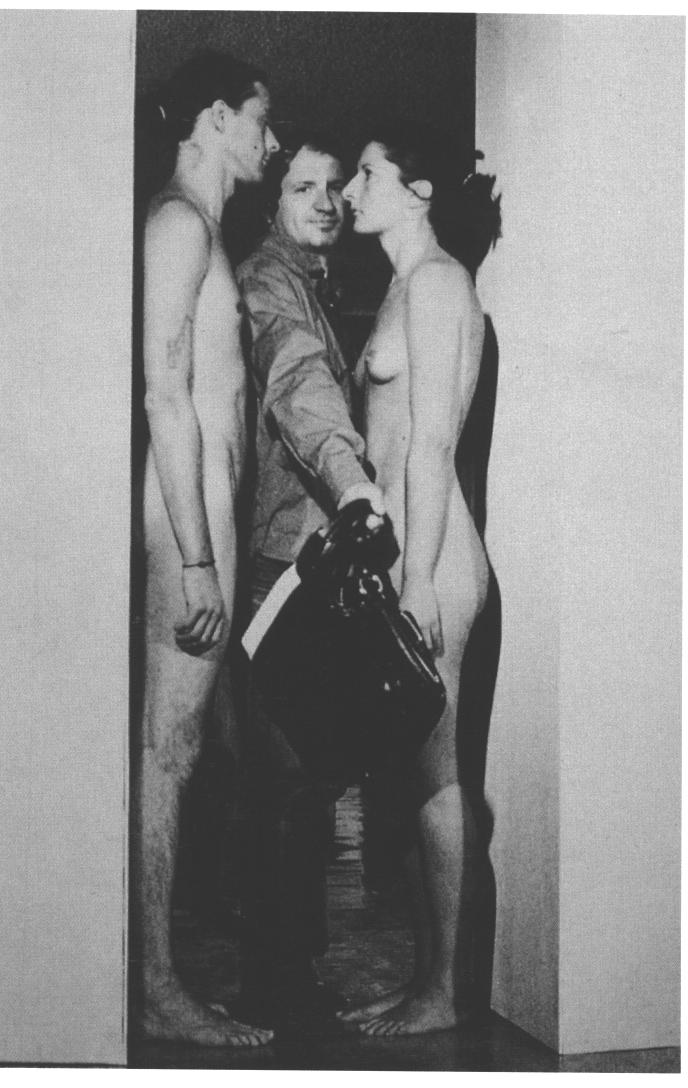
What I love about the debate over re-performance is exactly what Joan Jonas says is is wrong with it. The circumstances of the original performance can't be reproduced; the re-enacted performance just isn't the same. So the person or institution who buys a performance doesn't get the real thing. The real performance gets away! Its an excellent prank, I think, on a deserving victim. Real experience can't be commodified, the specifics of place and time can't either. Good for them! No where is this more obvious than in the re-staging of "Imponderabilia."
http://www.nytimes.com/2010/03/14/arts/design/14performance.html?pagewanted=2
Subscribe to:
Posts (Atom)